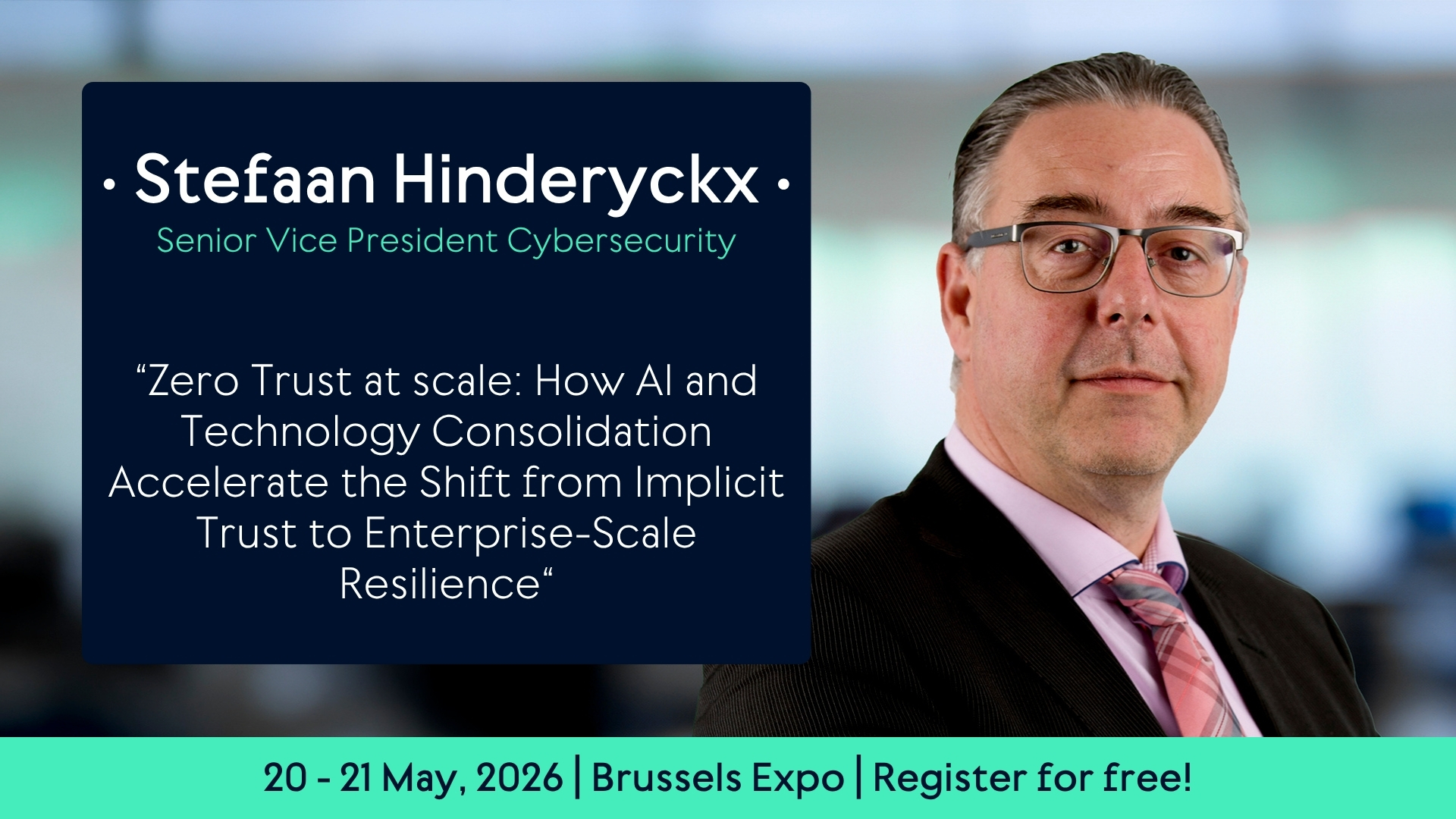
Zero Trust has moved from concept to priority, yet many organizations struggle to move beyond pilot programs. Fragmented tools, inconsistent policies, and limited visibility across hybrid environments often slow progress. At Cybersec Europe in Brussels on May 20 and 21, 2026, Stefaan Hinderyckx, Senior Vice President Cybersecurity at NTT DATA, will outline how enterprises can scale Zero Trust and build measurable resilience across users, devices, workloads, and data.
Why Zero Trust programs stall and how to scale them
Organizations are shifting from implicit trust assumptions toward continuous verification, but operational complexity remains a major barrier. Hinderyckx will explain how enterprise-scale Zero Trust requires consistent policy enforcement, identity-driven access, and unified visibility across cloud, on-premise, and hybrid environments. The session focuses on practical implementation, showing how cybersecurity and IT security teams can move from isolated controls to an integrated, risk-based architecture. This approach helps organizations improve risk management while maintaining agility and business continuity.
How AI and consolidation are reshaping Zero Trust
Two forces are accelerating the next phase of Zero Trust adoption. Artificial intelligence is transforming detection and response while also expanding the attack surface, requiring adaptive access decisions and continuous verification. At the same time, technology consolidation is simplifying operations by reducing integration challenges and enabling consistent telemetry and enforcement. Hinderyckx will discuss how organizations can balance these opportunities with governance considerations and dependency risks, while building a scalable Zero Trust framework.
Attendees will gain a clear enterprise roadmap, including where to start, which controls deliver the fastest risk reduction, and how to measure progress with outcome-based metrics. Stefaan Hinderyckx will speak on May 21 at Cybersec Europe in Brussels. Discover how AI and platform consolidation can accelerate the shift toward enterprise-scale Zero Trust resilience.